Sunday, 3 February 2013

Time for a change in the weather

Cold, damp, wet and grey - January 21st
There is a downside to living in Lincoln, or indeed to living in many parts of the UK in the winter. Some might say it's not just the winter, because they'll claim that there's always a problem with the  British weather. To some extent, that's true. Contrary to what the rest of the world likes to say about the weather, it isn't always raining but, on the other hand, it is very often grey, dull and rather melancholy.
Breathtakingly pretty - January 22nd

Earlier this month, we had a brief glimpse of how winter can be photogenic. One day was utterly miserable and then we awoke the next morning to a spectacular deep blue sky, and a crisp chill in the air that froze the snow in a delicate filigree on the trees


Yeah, right, and it was bloody cold.


Then there's the national inability to deal with anything other than minimal fluctuations in the weather. In summer, the road surfaces melt; in wet weather, the rivers flood and the drains overflow; in cold weather, the roads are treacherous. To be fair, the Council did a pretty good job with the roads, but the pavements have become a hotbed of litigious argument. Outside the pedestrian shopping areas, not one pavement was so much as brushed. Slush on the pavements froze into a lethal obstacle course. Apparently this is a deliberate course of action. It seems that if the pavements were cleared and then a pedestrian fell and had an accident,  there would be a case for a claim for compensation. So the roads are swept and gritted while the pavements are untouched.

Fortunately the Cathedral Estates department has a different attitude, and the drive outside my house was cleared perfectly and gave me a safe passage as far as the treacherous pavement at the roadside.
Lincoln - Kings Cross - Saint Pancras - Gatwick Airport
Enough is enough. It's time to head south.
I am invited to spend six weeks in Mauritius as a guest of a friend who runs what looks like a very attractive B&B.

I shall be expected to share various onerous tasks like preparing early breakfasts for guests who need an early start so they can swim with the dolphins, - and I shall have to drive them to the dolphin beach and probably go swimming with them. 
Once or twice a week I might have to cook extravagant dishes of seafood for guests who decide they'd like to eat in.  Such a tough call for a retired chef and passionate gourmet

I'll be back for Easter and will continue this blog then, meanwhile, if you're interested in learning about life in a different climate, you can follow my new blog from February 4th.

...not much to see, really!


Monday, 7 January 2013

A Little Bit of Lincolnshire History

Red Arrows at RAF Scampton
Lincolnshire has very few hills. It is flat and largely arable, making it ideal terrain for locating airstrips and aerodromes. Hence it is no surprise to discover that Lincolnshire became an important hub for RAF operations in the Second World War, and remains a prime location for the RAF to this day.There are jump-jets based in the south of the county and the famous Red Arrows display team is based at Scampton, a few miles north of Lincoln. Back in the WW2 days of Hurricanes, Spitfires and Lancasters, RAF Scampton achieved renown as the base from which Wing-Commander Guy Gibson led Operation Chastise, the
The Möhne dam breached by the raid
successful bouncing bomb raid on the Möhne and Edersee Dams that were seen as crucial in supplying hydro-electric power to the industrial heartland of the Ruhr.
There was something quintessentially British about Barnes-Wallis, the eccentric boffin who conjured up the idea of the bouncing bomb. When this character was teamed up with the Brylcreem and moustachioed glamour of the heroic RAF "few," there was material for an Elstree blockbuster, "The Dambusters," that was the Britain's biggest box-office hit in 1955. The film was broadcast again over the Christmas film-fest, and I found myself transported back to my childhood.
Wing-Commander Guy Gibson (centre)
It's a film I well remember, because it was my birthday treat in 1955, especially memorable for one incident. At one point, one of the airmen SWORE. It was in the sequence when the crews are practising low-level flying over Derwent Water and the navigator exclaims: "This is bloody dangerous!"
We four 11-year olds hooted and brayed. The character had said "bloody" - loud and clear, for everyone to hear in the film. "Bloody" was a totally unacceptable swear-word in 1950s Britain (bloody being a mediaeval abbreviation of By Our Lady)  It was shocking; and while we and all the other children in the audience collapsed with roars of laughter, the parents sucked their teeth and tutted audibly. How times have changed!
A different part of the script failed to make any impact in 1955 Britain, but was carefully dubbed for US distribution to avoid possible offence. The word in question was the name of a pet dog. Guy Gibson went everywhere with his beloved black Labrador, affectionately called Nigger. This was deemed inappropriate for American audiences and dubbed as Trigger. It is a sad sign of the times that one of the main talking points surrounding Peter Jackson's plans to shoot a remake of the film is what to call the dog. (The Lancasters needed for the film have already been built, but Jackson is currently seduced by The Hobbit trilogy.) Scriptwriter Stephen Fry proposes Digger while Executive Producer David Frost prefers Guy Gibson's nickname for his pet: Nigsy. Whatever happened to historical accuracy?
A Lancaster bomber flying over Lincoln Cathedral
This part of Lincolnshire relishes both past and present Air-force connections. The Battle of Britain Flight is now just one Lancaster, one Spitfire and one Hurricane, but I recall many occasions as a child, watching several of these WW2 stalwarts in flypasts.
Richard Todd in the role of Guy Gibson
Today, while computerised drones do the lethal work of eliminating targets without risk to the attacker, films of the Second World War depict a very different technology.
It came as a shock in the film to see the cumbersome leather and metal helmet that incorporated the microphone and headphones for the crew in the Lancaster cockpit. In another shot I was brought back to earth with the sight of the navigator using a slide rule to calculate position and time to destination. It is much easier to think of these people as war heroes than it is to admire a man in a bunker with a screen and a computer.
There is a growing debate over the use of drones, but I doubt whether intellectual outrage will change anything for the better. If war can be waged purely with technology, with very little human involvement, then most people living in the land of the aggressor will happily turn a blind eye. 
Drone warfare is probably another step towards Totalitarianism and clandestine operations. There will be no more war heroes, but maybe that's no bad thing.

Sunday, 30 December 2012

Meanings of Christmas


View up Bailgate with the market in full swing.
Lincoln hosts one of the largest Christmas markets in Europe, attracting at least 150,000 visitors over 4 days, arriving by coach and car from all over the Midlands and North as well as on luxury packages by chartered steam trains from London. 
I remember the first Lincoln Christmas Market in 1982,with  a Christmas tree that was delivered in true twin-town spirit, on top of a fire engine by the Fire Brigade of Neustadt-an-der-Weinstrasse,  Lincoln's twin town in Germany. In 1982 it was a homely affair with just 11 stalls, but this year,30 years on, there were nearly 300 stalls and, by all accounts, it was organised chaos.

Sheer pressure of numbers resulted in the implementation of total pedestrianisation in the central area of Uphill Lincoln, combined with a one-way system. Theoretically, I could only turn left from my front door and would then have to walk more than a mile to follow the one-way system to get back home. Fortunately, family commitments in Hampshire took me out of town for the weekend, so I avoided the horror of British mass tourism.

The majority of reviews on TripAdvisor rate the event as either "Poor" or "Terrible," with the following comment putting it bluntly:-
"It was an awful event and the organisers need to be much more truthful about it - in no way does it resemble any Christmas market that I've ever been to and the fact that huge numbers of people flock there every year does not make it good. It was cheap, tatty and nasty, very crowded and not in the slightest bit Christmassy."
But, as the saying goes: ...it's an ill wind...and at least the Cathedral prospered from the increase in visitors, with trade in the gift shop and coffee shop bringing in £34,000 and visitor donations totalling more than £25,000

For many people, Christmas is a consumerist bonanza. Children are encouraged to think about presents, while adults are encouraged to think about parties and over-indulging. Fortunately there are other aspects, even to the secular Christmas. Perhaps all the excesses lead people to stop and think of others and thus create a peak in charitable donations.

Certainly, Christmas is a time to stop and think, with the result that this is the start of the busy season for marriage guidance, and relationship counsellors. This is when people are forced to spend time together and all the buried anger and dissatisfaction rises to the surface and reveals the break-downs. Decisions have to be taken, and not all New Year resolutions bring happiness.

I think that in the end, we all put out own meaning on Christmas, in addition to any religious beliefs we might individually attribute to the traditional festival. For me, it's about that point between yesterday and tomorrow when we can stop and reflect and the past year, think about where we are today and look forward to where we will be in the year ahead. My 2012 was a huge terminal upheaval, just as the Mayans predicted. I am in awe of the future prospect and am determined to live it to the full. 

Linus van Pelt explained his thoughts to his close friend Charlie Brown, and I agree that "finding the inner child" is a very important aspect of the season. I want to reject all the negativity that adulthood brings us, and remind myself that anything and everything is possible. Happy New Year, everyone.

with acknowledgements to Peanuts by Schultz

Sunday, 18 November 2012

Bogof darling, Bogof...!

Bogof, Solzlhenitsyn, Tolstoy, Dostoyevsky. Bogof is clearly a name that belongs in the annals of great Russian writers, - except that you can't quite remember what he wrote or when he wrote it. Did he write that awful book about a paedophile? - no, that was Pasternak. Well, wasn't he that serious playwright whose scenes were endlessly depressing but awfully full of meaning? No, silly, that's Chekhov, or maybe Gorky... not Bogof.
The truth is that right now, in the 21st century, Bogof is extremely popular even though outsiders who unfamiliar with the genre, probably don't recognise the name.

Bogof's appeal is universal, which accounts for its widespread popularity. In fact you personally were almost certainly lured by Bogof within the past seven days. Bogof is everywhere, a well-proven asset in the arsenal - not of the writer or publisher, but of the marketeer.  Pile it high and sell it cheap...Buy One, Get One Free. B.O.G.O.F. It's another of those tedious management acronyms - the secret language of the commercial professionals. The rationale between Bogof is very logical: as long as I have stocks of brand Y on my shelves, I won't be tempted to buy brand X. In my classic GOM (grumpy old man) mode, I get angry with Bogofs, just as I get angry with 60% SALE discounts or just about any strategy behind selling kitchens and bathrooms. Does anybody pay the list price?

Ready-meals at TESCO                     [photo credit Route 79]
But what I dislike most about modern retailing - in supermarkets, in particular, - is not the pricing and promotion, but the way food is over-packaged into ready-meals and stacked on the shelves in plastic boxes. 
Yes, I know that's what the market demands, and I know that without the vast array of obscure products that sit on the shelf at Waitrose I would have to order my Ras-el-Hanout Moroccan spice on-line from Seasoned Pioneers, but I'm happy that I live in Lincoln, where street markets and farmers' markets and W.I. markets still thrive, and where real butchers cut, trim and tie meat to order.

Lincoln still boasts several traditional master butchers
Last weekend I went to my favourite butcher, down by the old covered Central Market, and was excited to see pheasants "in feather," hanging outside the shop. Unplucked pheasants give the buyer the opportunity to strengthen the gamey flavour by hanging them at home, and if I buy them unplucked, they are roughly half the price of when they are bought dressed and oven-ready.  When I had the restaurants  I learned the locals' trick of not bothering with the tedious business of plucking the birds; instead, you remove the whole skin and plumage in one easy movement, with none of the mess and palaver of struggling to pull out the feathers. 

I hesitated while I pondered whether to bard the birds with slices of bacon and roast them,  or joint them and simmer with  mushrooms and red wine in a casserole, or bone out all the meat (which would give me a carcase for the stock-pot,) then mix the pheasant-meat with pork and rabbit to make a richly-flavoured terrine of game. Not that I would let such mundane practicalities prevent me from postponing that decision and carrying a fine brace home on the bus, with the feathers protruding from the top of the carrier bag.

The view from my kitchen
But the reality is that there's just me, and so many of the dishes I used to love to prepare, demand at least a couple of other people at the table. I understand people with busy lives  who buy the ready-meals to dish up on a tray in front of the television. Many people see  food preparation as a chore, and not as relaxation and a creative outlet.

I have the luxury of a wonderful array of fresh produce in a county that supplies a high proportion of Britain's meat and vegetables. I also have the luxury of  time on my hands. What is less obvious is that my financial situation conveniently prevents me from eating out, buying  take-aways or living on convenience foods. It's a  happy twist of fortune, that economic necessity forces me to shop for raw ingredients  and then enjoy the creative opportunity of constantly experimenting with new recipes.

This afternoon I'll start work butchering and marinading the pheasants, in preparation for making a terrine of  game. It's a perfect dish for Christmas, when the family all get together.

Tuesday, 13 November 2012

Calm down dear...it's only a hurricane

Michael Winner is one of those people you love to hate. His restaurant reviews leave me thankful that he never (as far as I know) was a guest at one of my restaurants, but he has given us the "Calm down, it's only ..." catch-phrase that reached as far as parliament at Prime Minister's Question Time. It's very British to calm down demonstrate sang froid in the face of crisis, and when I was in Rhode Island last month on the day Hurricane Sandy arrived, my attitude was very much that people were over-reacting and the journalists were out trying to drum up a story.
New York: October 29th 2012
In Rhode Island, my son and I went out for a curry (how very British!) and ran between the showers. Less than a couple of hundred miles to the South in New York, it was a very different picture. The  hurricane took a formidable toll: 7.5 million people without power for several days, 16,000 flights cancelled, an economic cost of around $10/20 billion -and a death toll approaching 100. 
Wall Street was closed, the United Nations was closed and one of the world's great cities was forced to remember that it is also a coastal location.

Living through Hurricane Sandy, I now realise how easy it is to be totally isolated from what is going on around you and oblivious of the reality of human tragedy as it unfolds. Without television news and without all the infrastructure of modern communications,   people in Rhode Island or other neighbouring areas would have been totally oblivious to  the devastation faced around New York. Without "news" life just goes on.

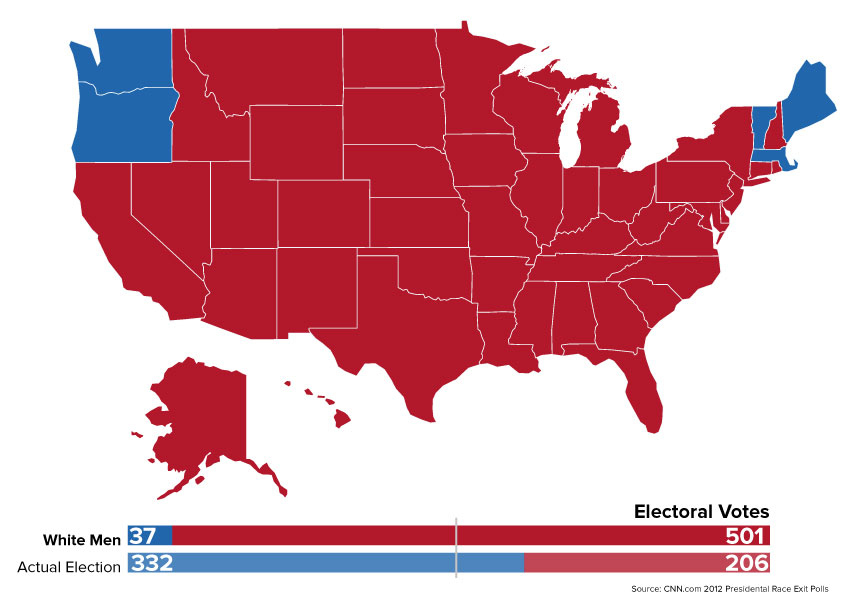
It's no exaggeration to say that the constant flow of news and information changes the course of history. The other distraction in Fall in New England was the Presidential election. Behind the hype, hysteria and massive media spend there lay a fascinating statistic:
2012 Presidential election, distribution of votes by race and gender - source CNN

The people who tried to stop Obama returning to the White House were white men. Without the female, the Latino, the African/American and native American voters, America would be a virtual dictatorship.

Look at the map and the numbers. Just how does that make you feel...? 

Calm down, dear, it's only the most powerful nation on Earth.


Friday, 26 October 2012

Doing something different

 I love the Channel Four television programme The Secret Millionaire.
Can I have a volunteer...?
Since I notice from the "Blogspot" statistics that I have readers of this blog as far away as Russia and the Ivory Coast, I had better give a basic outline of the way that this TV programme works. A millionaire goes away "under cover" for a period of 7-10 days to live in a deprived area, on an allowance equivalent to the minimum wage, looking at how things could be changed for less fortunate people through relatively small investments. At the end of the stay, the millionaire chooses how to donate a substantial sum of his/her own money to some of the projects that he/she has observed. (For more background, follow the link in my opening sentence above.) This programme always inspires me, and you soon realise that what makes the difference and sparks the change is not the money, but the people who are giving their time. 

The more I watched the programme the more envious I became of the millionaires; not of their money, but of the personal satisfaction they obviously derived from their involvement with a broad range of organisations and activities. So I did what they'd been doing on the TV programme and started to look around my home town for opportunities to get involved with voluntary activities.

I made an appointment for an interview at the Volunteer Centre, where I filled in forms and struggled to answer challenging questions about why I wanted to be a volunteer, and what relevant skills I might have. In the end it was suggested that I might be suited to becoming a "Progression Mentor" under the auspices of the Prince's Trust. I would be coaching and counselling young people into finding employment or becoming self-employed. (At this point I expect my own children will now fall about in hysterics at their memories of the experiences of the two Danish exchange students who, many years ago, ran out of our house in floods of tears and sat on the lawn, refusing to be moved until someone took them away to find a more gentle host family.) But I think I have matured in the subsequent 30-odd years and I might, today, have something to offer. It will, in any case, be a while before they let me loose on the young beneficiaries enrolled in the scheme.
You don't have to be Lord Sugar to help an apprentice
If all goes well then I shall be working as a volunteer, but I have a suspicion that I might find that I enjoy mentoring and coaching to the extent that I add this to my career portfolio and look for clients in the corporate world.(One of the ideas behind the volunteering movement is that it helps people find their niche in commercial activity.) Not that I am keen on getting into full-time business again and marketing myself because that's something I find just too  demanding. Once you work for yourself, you discover that success is 20% talent and 80% marketing. I find it depressing to see how self-promotion outperforms talent in many areas of business, but that is the reality. I'm not going to change at my age: my satisfaction comes from the impact of what I do more than from the money I make.

"I'm not sure what I want to do..."
A while back I wrote about the satisfaction of meeting people who had enjoyed meals in our restaurant, but that satisfaction was nothing compared to meeting the young people who had "Saturday jobs" at my restaurant, or who left school and started their careers as kitchen assistants - a glorified word for washers-up and vegetable-peelers. 
I have found it very rewarding when I have met people - now in their 30s and 40s  - who tell of the value of their school-years' part-time employment in the restaurant. They tell me how they learned to work as part of a team, and how much they learned about customer service from interacting with diners in the restaurant. And more...

It's all about confidence, self-respect   and ambition
Almost 15 years ago, I took my father out to celebrate his 85th birthday at what was Lincolnshire's top restaurant at that time, exclusively listed in the Michelin guide. 
As we pulled into the car park a young man in chef's whites strode out from the kitchen and gave us a cheery wave."Hello, Mr H" he said "I'm Second Chef here now!"  
Nothing could have made me happier...this young man had started in my kitchens on a Government-funded employment scheme, and for a while I almost despaired of his career prospects.

Today, that same young man runs his own highly successful restaurant. And that, above all, is why I look forward to volunteering and mentoring.

Saturday, 20 October 2012

Oompah...in Lincoln

It's October and that means Oktoberfest. Not only in Bavaria, it seems. The Rotary Clubs of Lincoln know a good fund-raising idea when they see one and if it involves the consumption of large quantities of beer, then it doesn't take too much persuasion to drum up an enthusiastic response. They got together to rent the events centre on the Lincolnshire Agricultural Showground and persuaded the town band of a Bavarian village to come over and join with the Lincolnshire Fire & Rescue Concert Band to create an authentic event. 
2012 - Lincoln's First Oktoberfest 
But the Musikverein Lengenwang is more than an amateur Oompah Band and would do more than play in the beer tent. 
Rotary had arranged a series of concerts in the High Street, in Castle Hill and in the Cathedral.  Given that the videos on their website showed them performing the rowdy “Prosit!” toast at their own local Oktoberfest, I rather wondered what their repertoire might stretch to in the cathedral. There had to be a story here somewhere, and being intrigued by the background of the  Musikverein Lengenwang, I “googled” it in my best fact-checker and investigative journalist mode. 

Neuschwanstein Castle
I discovered that Lengenwang is a community of just 1,365 inhabitants living in 14 hamlets nestled in the foothills of the Bavarian Alps, not far from the famous castles of the eccentric King Ludwig II at Hohenschwangau.
The Club dates back to 1846 and now has a youth division of 19 members in addition to the main band of 45 musicians. That means roughly 5% of the local population play in one or other of the bands – a serious commitment to their music. 

Alas, by the time I felt tempted by the idea of the Lincoln Oktoberfest, the event was a total sell-out. Well done Rotary! - and a welcome boost for the coffers of the chosen charity - Linkage Community Trust which provides care, specialist further education and employment services to enable people with learning disabilities  to realise their full potential.
Alas, no beer in the cathedral!
So no blonde Fraulein would be leaning over the table with a litre of beer for me, but I could get the flavour of their music by walking  across the road from my flat to the cathedral for the Friday lunchtime concert. 

I took my seat in the main nave of the cathedral, somewhat bemused by the traditional dirndl dresses and big Guy Fawkes hats of the lady members of the band and the bucolic breeches and white stockings of the men. The composition of the band was  stereotypical to the point of caricature. The earnest conductor & musical director wore a full moustache and a broad smile as he bowed deeply to acknowledge the welcoming applause of the small but appreciative audience. There were no programme notes to reveal his identity, but he must have been the local schoolmaster and/or church organist. Then there was the teenage percussionist – who looked like every boy drummer in every boy-band on X-Factor. There was the obligatory ice-maiden sylph-like flautist, with looks that could kill, and a back row of red-cheeked, beer-bellied trombonists any one of whom could have doubled for Jimmy Edwards in his prime and had the moustache to prove it.

A performance of outstanding musicianship
All my fears and cynicism proved totally unfounded. The band delivered a faultless programme of classical music and regional tunes that were totally in keeping with the setting of the cathedral nave. The sound of a full-strength brass band in the acoustics of the cathedral was stunning and my only regret was that they didn’t allow themselves to go up-tempo for just one or two numbers. Lincoln Cathedral can take it. There are more than 40 concerts and recitals in the cathedral every year from the Hallé Orchestra to organ recitals, military bands and contemporary jazz. It would have been nice to have a bit of Oompah-pah. 
As they left the austere Uphill surroundings and went off and helped create Lincoln's first proper Oktoberfest, the cathedral returned to normal... but at Lincoln Cathedral, that could mean anything.

I can only hope that the fears that the band had expressed on their website proved well and truly unfounded: “Jetzt bleibt nur noch zu hoffen, dass das englische Bier so gut schmeckt wie daheim in Bayern” – Roughly translated as – “Let’s just hope that beer in England  tastes as good as beer back home in Bavaria." Well - if it was Bateman's of Wainfleet they should not have been disappointed.
Musikverein Lengenwang